
The Eisenhower Principle in the Age of AI: How to Achieve More with Less Effort
You know the feeling: your inbox is overflowing, three deadlines are looming at the same time, and at the end of the day, you feel like you haven't accomplished anything important. In a working world shaped by constant availability and information overload, we quickly lose focus.
But what if you had a method that not only tells you what to do next, but an Artificial Intelligence even helps you get half of it done? Welcome to the Eisenhower Principle in 2026.
What is the Eisenhower Principle?
The Eisenhower Principle is named after the former US President Dwight D. Eisenhower. It is based on a simple but ingenious distinction: Is a task important? And is it urgent?
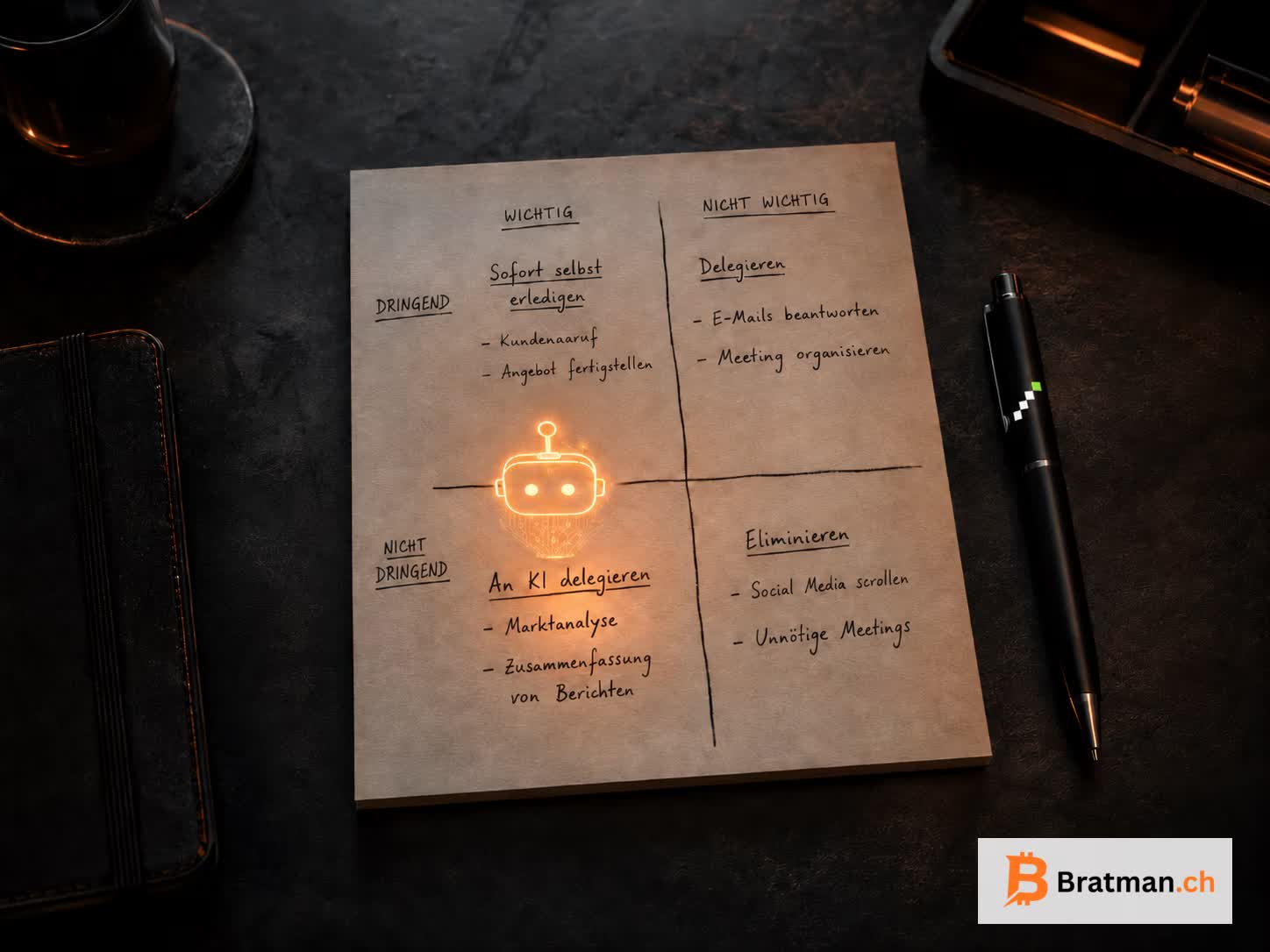
This results in a matrix with four quadrants:
- Important & Urgent (Do): Crises, acute problems, tight deadlines. You must do this yourself immediately.
- Important, but not urgent (Decide/Schedule): Strategic planning, further education, relationship building, long-term goals. This is where the true value of your work lies. Schedule fixed times for this in your calendar.
- Not important, but urgent (Delegate): Interruptions, lots of emails, some meetings. Tasks that demand immediate attention but do not bring you closer to your goals. You should delegate these.
- Not important & not urgent (Delete): Time-wasters, trivialities, mindless scrolling. You cross these tasks out completely.
Most people spend their time in Quadrant 1 (stress) and Quadrant 3 (external determination). However, the goal is to spend as much time as possible in Quadrant 2.
The Gamechanger: AI in Quadrant 3
Historically, the 3rd quadrant (delegating) was a problem for most employees. If you don't have an assistant or a team under you, it's hard to delegate tasks. You had to grit your teeth and do these things yourself.
This is where AI changes everything today.
Artificial Intelligence is your personal, highly competent assistant. You can delegate tasks from the 3rd quadrant to it. Some examples:
- Taming the email flood: Have AI draft routine emails or summarize long threads. You only need to take a quick look and send.
- Research & data preparation: Need a summary of a 50-page report? Or need to transfer data from a PDF into an Excel format? This is no longer work for humans.
- Application process: Do you spend hours tailoring CVs to every single job posting? Use the AI writer from PARAT to generate tailored cover letters in seconds. You take final control, the machine does the busywork.
More Time for Quadrant 2
By outsourcing the 3rd quadrant to AI and consistently ignoring the 4th quadrant, you gain a massive amount of time. This time flows directly into the 2nd quadrant: the important but not urgent tasks.
This is where real innovation happens. This is where you prepare for that important conversation with your boss, instead of just fighting fires. This is where you learn new skills (perhaps even how to better use AI tools). This is where you plan your next career step.
How to Start Tomorrow
- Draw the matrix: Take five minutes tomorrow morning. Draw the four quadrants on a sheet of paper.
- Assign tasks: Distribute your daily to-dos across the quadrants. Be brutally honest with yourself.
- Ask the AI question: Look at all the tasks in the 3rd quadrant and ask yourself for each one: "Can an AI do this faster or at least create a first draft?"
- Focus: Complete Quadrant 1, schedule Quadrant 2, delegate Quadrant 3 to AI (or colleagues), and delete Quadrant 4.
The Eisenhower Principle is old, but in the age of Artificial Intelligence, it is more powerful than ever. Use it to work not just harder, but above all, smarter.